A Proven, Non-Invasive Path to Lasting Pain Relief

The Osteoarthritis Challenge

Over 32 million Americans live with osteoarthritis — the most common joint disease. Pain, stiffness, and disability reduce quality of life and cost the U.S. economy $85+ billion annually in direct medical expenses.

Conventional Treatment Limitations

  • NSAIDs carry GI & cardiovascular risk
  • Steroid injections damage cartilage over time
  • Opioids: addiction risk & limited efficacy
  • Joint replacement: major surgery, long recovery
  • Physical therapy: helpful but often insufficient alone

32M+

Americans with OA

$85B

Annual U.S. Medical Cost

18.7M

Working-Age Adults Affected

$2,018

Average Cost Per Patient/Year

What is Low-Dose Radiation Therapy (LDRT)?

A century-old, clinically validated treatment — now available at CRC

Anti-Inflammatory Mechanism

At doses <1 Gy per fraction, radiation suppresses pro-inflammatory cytokines (TNF-α, IL-1), reduces macrophage activity, and dampens the inflammatory cascade — without the systemic risks of NSAIDs.

Precisely Targeted

Treatment is delivered directly to the affected joint — knee, hip, hand, shoulder, foot — using CT-guided planning. Only the joint and surrounding tissue receives radiation.

Brief Course of Treatment

6 fractions of 0.5 Gy each, delivered 2–3x per week. Each session takes under 10 minutes. Total course: 2–3 weeks. Outpatient, no anesthesia required.

Exceptionally Safe Profile

Dose is 1/100th to 1/200th of oncologic therapy. Zero reported cases of radiation-induced malignancy in OA patients. Virtually no side effects (Grade 0–1).

The Clinical Evidence Is Clear

Osteoarthritis (OA) — Key Studies

Multicenter Retrospective
Rühle et al., 2021
n=970 patients / 1,185 sites

65–90% pain relief

Prospective
Alvarez et al., 2022
n=100 patients (Hand OA)

Significant reduction at 3, 6, 12 mo

RCT (Germany)
IMMO-LDRT01 Trial
n=250 patients

Pain: 6.5 → 3.8 VAS; anti-inflammatory immune changes

Multicenter RCT
ArthroRad Trial
n=133 pts / 244 joints

Superiority of 0.5 Gy vs. very low dose confirmed

Source: Rühle 2021, Alvarez 2022, IMMO-LDRT01, ArthroRad Trial, Ott 2012, Hautmann 2014, Rudat 2021

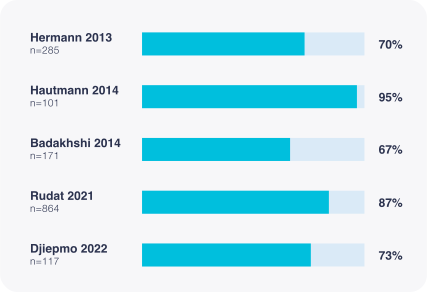
Plantar Fasciitis

LDRT Response Rates

Overall: 1,538 patients — 81% Response Rate

Why LDRT Is a More Cost-Effective Long-Term Treatment Option
One-time cost. Lasting relief. 5–10× more cost-efficient over 3–5 years.
Treatment Factor✓ LDRTConventional Management
One-Time Cost
$6,000 – $8,000
$8,000 – $22,000
Duration of Relief
1–3 Years
Short Term
Side Effects
Minimal (Grade 0–1)
GI, Cardiac, Addiction
Anesthesia
None
Often Required
Systemic Risk
None
Significant
5-Year Total Cost
$6,000 – $8,000
$40,000 – $110,000+

LDRT covered by Medicare & major private insurers (Evicore guidelines, Page 172 Section T) — minimal prior authorization issues

Who Is a Candidate for LDRT?

Ideal Candidates

  • Adults 45+ with confirmed osteoarthritis
  • Moderate-to-severe OA
    (symptom stages: medium to late)
  • Failed or intolerant to NSAIDs / PT / injections
  • Seeking non-surgical alternative before joint replacement
  • Knee, hip, shoulder, hand, wrist, ankle, or foot OA
  • Plantar fasciitis or tendinopathy (also responsive)
  • Patients who prefer to avoid systemic medications

Joint Sites We Treat

Knee
Most common — bilateral possible
Hip
Full joint space included
Hand & Fingers
All joints, 1cm bolus
Wrist
Opposed beam technique
Shoulder
Lung blocking used
Ankle & Foot
Vaclock or Aquaplast setup
Plantar Fascia
Heel spur / fasciitis

Your Treatment Journey at CRC

Simple. Outpatient. No surgery. No anesthesia.

Consultation

Meet with our radiation oncologist to evaluate your OA, review imaging, and confirm candidacy.

CT Simulation

A brief CT scan maps the joint for precise treatment planning. Custom immobilization device created.

Treatment Planning

Dosimetrist and physicist design your personalized radiation plan targeting the joint and surrounding tissue.

6 Fractions Treatment

0.5 Gy per session, 2–3x per week, over 2–3 weeks. Each visit is under 10 minutes. Fully outpatient.

Follow-Up at 3 Months

Pain & function scoring. If significant pain persists, a second course is available. Most patients see relief within 6 weeks.

Retreatment Option: 30–40% of patients may benefit from a second 6-fraction course, assessed at 3-month follow-up. Same dose, same protocol.

Why Choose Capital Radiosurgery Centers?

Expert. Compassionate. Accessible.

Specialized Expertise

Our radiation oncologists are trained specifically in LDRT for benign conditions — not a side service.

Medicare & Insurance Covered

We handle prior authorization. Evicore guidelines (Sec. T) support coverage for degenerative skeletal disorders.

Minimal Time Commitment

6 outpatient visits of <10 min each. No hospital stays, no recovery time, no work disruption.

Evidence-Based Protocol

Our protocol follows DEGRO, RCR, and leading published research — 0.5 Gy × 6 fractions, CT-planned.

Referral Partnerships

Growing referral network with primary care and orthopedic specialists. Co-management supported.

Outcomes We Track

We monitor pain scores at 3, 6, and 12 months. Our results align with the 65–90% response rates in literature.

Care All in One Place

Technology is only part of the equation. At CRC, every step—nursing, care coordination, therapy, dosimetry, and oncology—is handled in-house, creating a seamless, patient-centered experience from consultation to treatment completion.


What to Expect

See what to expect during treatment and how we guide you every step of the way.